
By Evan Coffey & Kate Templeton
A rocket company became one of the most valuable businesses on Earth in a single afternoon in June. Five weeks later, its stock traded below where it started. The technology underneath it, the part that took a decade to build, hadn’t changed at all in that stretch. Only the price had.
That gap, between how fast a verdict arrives and how slowly the thing being judged actually moves, shows up everywhere in this story. Space may well be the next great infrastructure buildout. It may also take longer to prove that than the market is currently willing to wait.
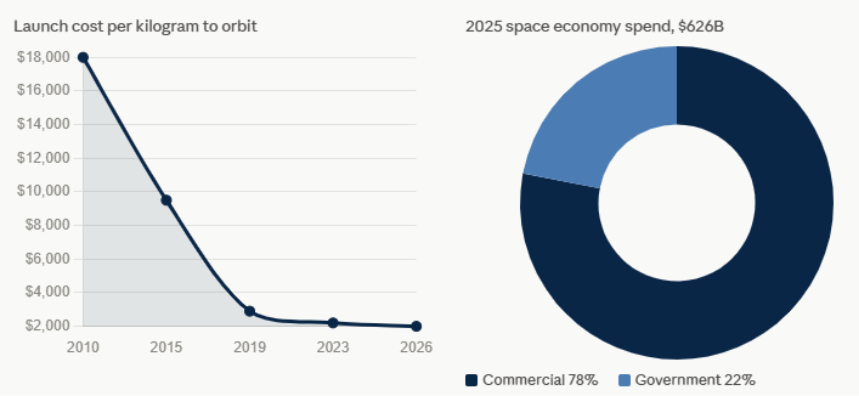
The space economy generated $626 billion in 2025, a figure that sat almost entirely inside government budgets and specialized contracts for decades. Commercial activity now accounts for close to 78% of that total against 22% government spend. Estimates for when the industry crosses a trillion dollars in annual value range from the early 2030s to 2035 depending on the source, but the scale was real long before this year. What changed in 2026 was the market’s willingness to price it, aided by a genuine cost curve: reusable first stage boosters have cut launch costs from roughly $10,000 – $20,000 per kilogram to about $1,500 – $2,700 per kilogram. That’s the primary driver.
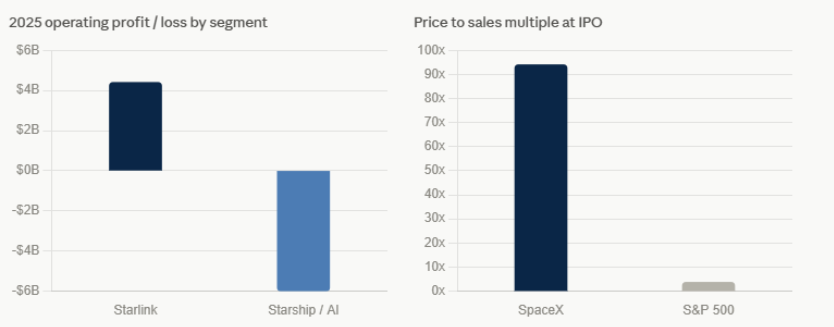
Stock prices picked up on that story faster than the fundamentals could keep pace. Space focused ETFs that were up 40% – 50% earlier this year have given much of that back, with many now only up 12% – 13% YTD. For individual stocks the moves were even more amplified. One satellite imaging company gained over 400% by May and has since fallen back to Earth, with shares at less than $4, well off 52-week highs near $12. SpaceX itself listed in June at a valuation near $1.8 trillion, and the company’s own filings told a more complicated story than the headline suggested. Starlink was the only profitable division, generating over a billion dollars in operating profit in a single quarter, while billions in losses came from Starship and the company’s newer AI computing ambitions. Investors were being asked to price one proven business and two unproven ones as a single bet and largely did.
That pricing had a second effect. Strategists began describing SpaceX as the anchor of the sector, reasoning that once the largest name commands a trillion-dollar valuation, smaller players screen as undervalued simply for sharing its demand cycle. The logic sounds sound. Whether it holds up is a different question.
Those same strategists unintentionally revealed to investors what bias to look for. They called SpaceX an anchor and meant it as a compliment. Investors should take it as a warning. Anchoring bias works exactly how the word sounds. The first number sets the standard that every number thereafter is measured against. What the business is actually worth is not a factor.
Building on this point, at IPO, SpaceX traded at nearly 94 times sales, more than 25 times the S&P 500’s multiple of around 3.7. Many buyers of the stock acknowledged that the math was questionable, yet they bought it anyway. That reaction is not a failure of judgement. It is simply the bias working as it is meant to. Here is what makes anchoring so convincing. A trillion-dollar valuation was presented with a bank syndicate and a prospectus to back it up. The documentation made it seem like the vetting process was over. Instead, it was still just a proposal. The anchor was never tested. That’s the beauty of the bias. It just had to be first.
Starlink, Starship, and SpaceX’s AI segment are three different businesses with three different track records. Starlink has been profitable for years, showing no signs of slowing down. Starship has been in development for a decade. The AI segment was brought into the fold just months before the IPO. A rocket company that built the largest satellite network is now trying to build the next best AI company. That is narrative fallacy. If the story makes sense, most people never check its credibility.
The numbers were not hidden and would not have matched the story had anyone checked. Starlink generated $4.4 billion in operating profit in 2025, while the AI segment simultaneously lost more than $6 billion. The story made no distinction between the two segments’ profitability. Its credibility was built entirely off Starlink’s numbers, so investors were never pushed to take a deeper look at the AI division. This has become a pattern during the AI build out. The focus keeps shifting, from robotaxis to humanoid robots and now to orbital compute, moving to the next business venture before anyone can check if the last one delivered results. This shift is not accidental. The bias is successful in this case because each venture borrows credibility from the hype of the last. This reveals the real problem behind narrative fallacy. The claim is not that the story is false, it is that the story is built so investors never have time to keep up with it.
None of this is new. In May 2019, Uber priced its IPO at $45 a share, valuing the company at $75.5 billion. It began trading at $42 and closed the day at $41.57, wiping out $655 million in market value in a single session, the biggest first day dollar loss of any IPO in US history. The verdict was immediate and it was brutal. Market commentators called the offering a failure before the company had reported a single quarter as a public business.
In this case, the initial verdict was wrong, or at least early. Uber spent a month trading below its offering price before climbing back above it. By early 2024, Uber was trading at $80 a share, more than 75% above where it was priced 5 years earlier. The thesis that ride hailing would become a real, durable business turned out to be correct. Being right about that took years. The market’s first opinion took a single afternoon.
This is the behavioral gap the market is pricing today within the space industry and the AI bets riding alongside it, and it’s worth sitting with rather than resolving. The technology underneath the space economy may prove out exactly the way Starlink already has. The businesses bundled around it may not. History says both of those things can be true of the same company at once, and the crowd’s first verdict, in either direction, rarely knows which is which.
Kate Templeton | Associate, Asset Management
Kate is an Associate on GVA’s Asset Management Team, where she specializes in operations, advisor communication, and strategic account analysis. Kate’s strong analytical thinking and close attention to detail drive her success in streamlining workflows and generating data-driven insights that enhance reporting quality and operational performance.
In 2024, Kate graduated summa cum laude from Ursinus College with a BA in Applied Economics and minors in Management Studies and Psychology. During her time at Ursinus, Kate was a member of the Ursinus College Investment Management Company and the Omicron Delta Epsilon and Psi Chi honor societies. She also served as vice president and social media coordinator for her sorority, Phi Alpha Psi.
Outside of work, Kate enjoys going to the beach, doing pilates, spending time with friends and family, and keeping up with reality TV.
Evan Coffey | Investment Analyst, Asset Management
Evan is an Investment Analyst on GVA’s Asset Management Team. He specializes in investment research and has a passion for finance and economics. Evan uses his strong work ethic and financial literacy to help manage GVA’s multi-asset portfolios, mitigate risk, and help coordinate wholesaler relationships. In the Spring of 2024, Evan graduated as valedictorian from Ursinus College with a BA in Finance and a minor in Management Studies. Evan took part in Finance Scholars and was a CEO of the Ursinus College Investment Management Company. Evan was also inducted into Phi Beta Kappa and Omicron Delta Epsilon during his time at Ursinus. Outside of his coursework, Evan was captain of the men’s golf team and worked on a year-long honors project focusing on the stock-bond correlation and how macroeconomic variables affect the relationship between the two asset classes.
Prior to joining GVA full-time, Evan interned with GVA’s Asset Management team! During his time as an intern he focused on equity research, and shadowing wholesaler and advisor meetings. Under the guidance of the GVAAM team, Evan gained quality professional experience in the finance and asset management industry. Outside of Finance and Economics, Evan enjoys golfing, watching Formula 1 racing, going to Sixers games, and traveling with close friends and family.
Disclosure: I/we have no stock, option, or similar derivative position in any of the companies mentioned, and no plans to initiate any such positions within the next 72 hours. I wrote this article myself, and it expresses my own opinions. I am not receiving compensation for it. I have no business relationship with any company whose stock is mentioned in this article.
Investment advice offered through Great Valley Advisor Group (GVA), a Registered Investment Advisor. I am solely an investment advisor representative of Great Valley Advisor Group, and not affiliated with LPL Financial. Any opinions or views expressed by me are not those of LPL Financial. This is not intended to be used as tax or legal advice. All performance referenced is historical and is no guarantee of future results. All indices are unmanaged and may not be invested into directly. Please consult a tax or legal professional for specific information and advice. LPL Compliance Tracking #1151010
The economic forecasts set forth in this material may not develop as predicted and there can be no guarantee that strategies promoted will be successful. All investing involves risk including loss of principal. No strategy assures success or protects against loss.