
By Eric Hough
In my best Steve Harvey voice: “We surveyed two hundred advisors on the optimal 2026 portfolio allocation for high-net-worth clients, and the top answer is on the board”
Survey Says: There is no number one answer! There is no consensus and no single model dominates!
Ok, I confess, I didn’t poll any advisors. However, there has been a set of recurring themes surfacing across my advisor and investment committee discussions in recent weeks:
- Fixed income has delivered minimal total return in the current cycle, with continued concern about duration exposure.
- Capital within real estate allocations is rotating toward core real assets.
- Risk modeling increasingly shows that defensive equities can outperform bonds during rate-driven equity selloffs.
While this is not a formal survey, independent data lends support to these observations. Long Angle, a private peer community of roughly 8,000 entrepreneurs with net worth ranging from $2 million to $100 million, maintains a body of vetted allocation research that corresponds closely to the themes noted above.
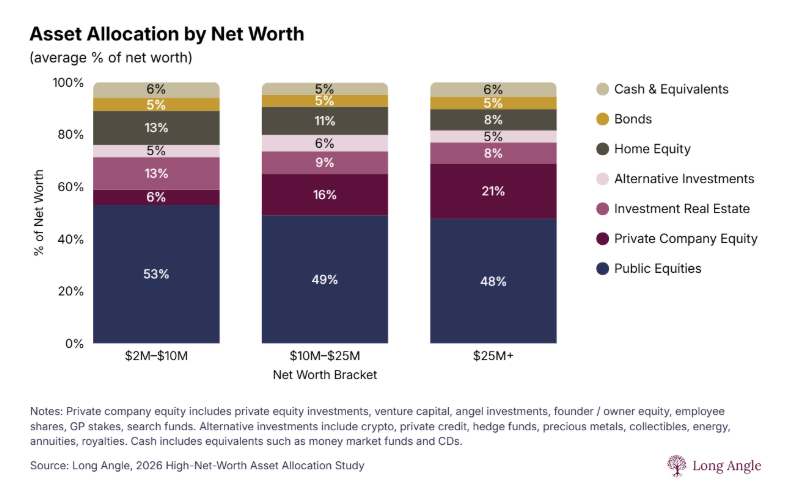
Two observations stand out. First isfixed income constitutes a strikingly small share of these portfolios. Even aggregating bonds with cash equivalents, the shortest duration allocation, the combined weighting averages roughly 10% across net worth portfolio, a material departure from the traditional 60/40 framework. Second,net worth appears to scale with allocation to investment real estate. The dataset does not establish causality, but it raises a legitimate question: Why would investors favor real estate over bonds at increasing rates as wealth grows?
The investment case for real estate has strengthened meaningfully for high-net-worth investors seeking income, diversification, and tax efficiency. Fixed income continues to serve as a reliable source of predictable income, but the passage of the One Big Beautiful Bill Act (OBBBA) materially improves the after-tax economics of qualifying real estate investments by permanently restoring 100% bonus depreciation for property acquired and placed in service after January 19, 2025.
For investors in higher tax brackets, this is not a marginal distinction. Through cost segregation studies, a portion of a real estate investment can be reclassified into shorter-lived depreciable asset categories, accelerating deductions available to offset current taxable income. The resulting profile is uncommon in a single asset class: current cash flow, potential long-term appreciation, and meaningful tax deferral. It is worth emphasizing that this benefit is generally a matter of timing rather than permanent tax elimination. Depreciation reduces cost basis and the associated gain is taxed on the recaptured upon sale.
Real estate also offers a structural characteristic that bonds generally can’t through direct exposure to underlying economic growth and inflation. Rental income and property values tend to rise over time, and certain lease structures and property types provide explicit inflation-linked income. A fixed-rate bond, by contrast, delivers a predetermined stream of interest and principal with limited built-in inflation protection.
For investors seeking counterbalance against equity market downturns, core real asset strategies could warrant attention. Specifically contracted infrastructure (power and renewables), regulated essential infrastructure (water, gas, and electricity), and essential real estate (grocery-anchored, pharmacy, and medical properties). These categories are structured to generate durable income while avoiding the elevated leverage and cyclicality inherent in value-add and opportunistic strategies.
A word of caution is warranted. The term “infrastructure” is not a guarantee of defensive positioning. A highly levered fund concentrated in merchant power, development-stage data centers, or cyclical transportation assets can carry substantially more downside risk than a conservatively levered core real estate strategy. Manager selection and underlying leverage matter as much as sector labeling.
For high-net-worth investors, the relevant question is not real estate versus bonds in isolation, but a comparison of after-tax total return across both asset classes. When tax-efficient depreciation is combined with current income, inflation protection, and appreciation potential, a high-quality real estate investment can represent a compelling complement to rather than a replacement for traditional fixed income within a diversified portfolio.
Eric Hough | Director, Asset Management
Eric Hough joins Great Valley Advisors as Director of Asset Management, specializing in Alternative Investments. In this role, he will oversee portfolio strategy, manage fund investments, and build lasting investor relationships. With extensive Wall Street experience and deep expertise in alternative assets, Eric is well-positioned to deliver meaningful value to clients while advancing the firm’s long-term growth initiatives.a, and CFA Magazine.
Disclosure: I/we have no stock, option, or similar derivative position in any of the companies mentioned, and no plans to initiate any such positions within the next 72 hours. I wrote this article myself, and it expresses my own opinions. I am not receiving compensation for it. I have no business relationship with any company whose stock is mentioned in this article.
Investment advice offered through Great Valley Advisor Group (GVA), a Registered Investment Advisor. I am solely an investment advisor representative of Great Valley Advisor Group, and not affiliated with LPL Financial. Any opinions or views expressed by me are not those of LPL Financial. This is not intended to be used as tax or legal advice. All performance referenced is historical and is no guarantee of future results. All indices are unmanaged and may not be invested into directly. Please consult a tax or legal professional for specific information and advice. LPL Compliance Tracking #1159000
The economic forecasts set forth in this material may not develop as predicted and there can be no guarantee that strategies promoted will be successful. All investing involves risk including loss of principal. No strategy assures success or protects against loss.